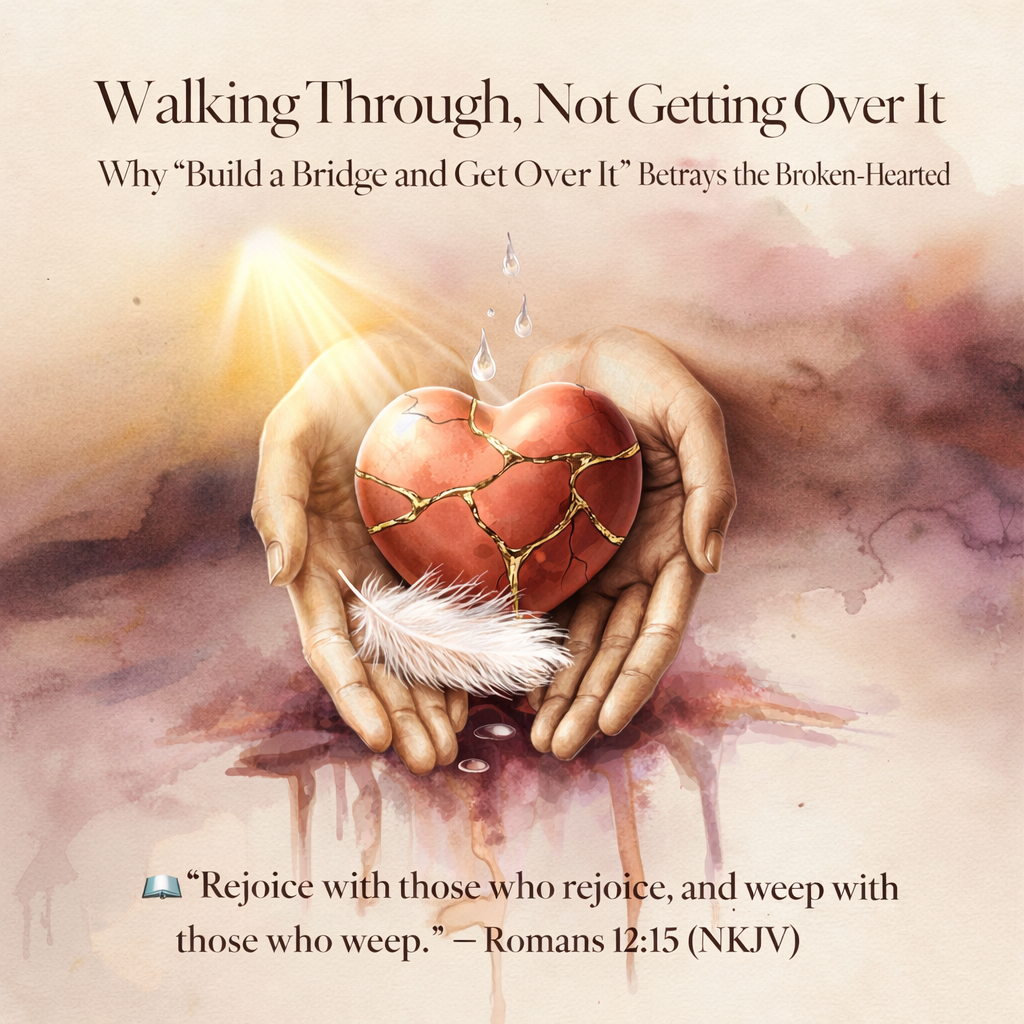
Why “Build a Bridge and Get Over It” Betrays the Broken-Hearted

🕯️✍️📖🕊️🪨🌱
This morning, Roland and I were in our daily rhythm of rolling towels at The Crate, talking about Encounter Group rhythms, numbers, and locations, when he paused and said, “Let me ask you something because I hear this from some people and I think it’s a little bit insensitive. You know, when someone has a problem, it could be a mental problem or just something that’s happened in their life. There’s a phrase called ‘build a 🌉bridge and get over it’. How does that sit with people like that? 🤔”
His question brushed up against the chapter I am writing on miscarriage and loss.
My answer came quickly.
“It is a dismissal. It is insensitive. It invalidates trauma and grief.”
What I shared with him briefly is something I am working through more fully in my book.
A few weeks after I had just started a new job, which brought me to The Crate in 2024, I received an email addressed to Pru. That name resurfaced something in me. Something inside me jolted. Twenty-eight years dissolved in a breath. My body remembered April 1996 before my mind could reason. A sterile office. The sharp edge of judgement. The humiliation of being told that my loss was not real enough to grieve.
During my interview she had asked whether we were planning children. At that stage, Clive and I were not, so I said no. Six weeks into the job, I was hospitalised for three days with what was first called a “threatening abortion” and then diagnosed as an ectopic pregnancy. I was rushed into surgery on day two. A tiny life was gone before it had even been announced.
The gynaecologist explained that my pregnancy symptoms would likely continue until my original due date passed or until a new pregnancy began. My body would carry on as though life still grew within me, even though that little heartbeat had already fallen silent. Grief was not only emotional. It was physical. My body had to unlearn what it had already begun.
When I returned to work, I did not receive compassion.
“Get over it. Six weeks pregnant wasn’t even pregnant.”
Those were her words.
After that, nothing I did was ever quite right. The harder I worked, the more I seemed to fail at perfection and the more I beat myself up for failing. I shut down emotionally. I numbed myself. I pushed the grief down because it was clear there was no space for it.
I was already fragile, trying to prove I was responsible, capable, worthy of the role I had only just begun. Instead of tenderness, I was met with irritation. Instead of understanding, discipline.
Something inside me cracked.
The sorrow of losing a baby collided with the shame of being treated as an inconvenience. I learned quickly that emotional pain was unwelcome. Weakness would not be tolerated. Silence became armour. Perfection became protection.
Armour, however, is heavy.
One evening, Clive found me on the floor sobbing as he got home from work. The grief I had buried was eroding me from within, and the treatment I had received at work that day hurt so much that he phoned her in anger to tell her off for being so unkind, which only intensified the hostility at work. Antidepressants followed.
Seven months later, I was pregnant again, and pressure mounted as Pru was pushing discussions with the regional manager around disciplinary action. When I told Clive about that, he immediately ordered me to resign, because he wasn’t willing to risk this pregnancy with that amount of stress. Trevor’s kindness in sending me home that day on full pay until the end of December was a small mercy in a season that had felt largely merciless.
Still, the deeper wound remained.
Three more miscarriages followed in the years ahead, each one unannounced and unspoken, hidden beneath the rule I had internalised: do not tell until after twelve weeks, do not risk humiliation again, do not expect comfort.
That is what happens when grief is told to get over itself.
We are not meant to get over loss. We are meant to move through it.
Only when we move through it to process it does the memory lose its sting.
There is no building bridges over trauma. Temporary survival strategies train the heart to self-protect. They harden what was meant to stay tender. What remains ungrieved resurfaces later as anger, anxiety, or patterns we cannot explain, sometimes even escalating into violence.
I think of the many moments when grief was told to be reasonable, when loss was expected to behave, when a mother’s empty arms were answered with, “get over it,” or when mourners were told, “they’re with Jesus now.” Those words are thin bandages. They cannot carry the weight of what has died.
Heaven is real. Our loved ones may indeed be with Jesus. Yet truth offered without tenderness can still wound. When my spiritual mum passed away last year, someone said, “Rejoice, she’s with Jesus now.” I knew it was theologically true, yet inwardly I concluded that my grief was inappropriate. So I buried that too.
📖 “Those who sow in tears shall reap in joy. He who continually goes forth weeping, bearing seed for sowing, shall doubtless come again with rejoicing, bringing his sheaves with him.” — Psalm 126:5–6 (NKJV)
Scripture does not rush tears. It dignifies them.
Weeks later, I sat in the business lounge, burying my grief in work, when Elias came by and offered me a cup of tea. I graciously accepted, yet I was withdrawn, barely looked at him because I was afraid he’d see the tears threatening to flow and he quietly left. (It dawned on me as I got home later that I must have appeared rude. Was he there to chat?🤔) A few hours later Dean came up behind me. “Good morning, bringer of joy,” he said, hugging me from behind as he had done so many mornings before. “I’m sorry,” I replied, “bringer of joy is grieving and will be back soon, I hope.” He didn’t utter a word, simply held me a little tighter and lingered a little longer. For the first time since Aunty Delice passed, I felt heard, seen, and validated.
As Christians, we must learn to walk with people through their valleys. Scripture calls us to weep with those who weep, yet tears often unsettle us. We reach for verses too quickly. We tidy what God designed as a sacred expression.
📖 “Rejoice with those who rejoice, and weep with those who weep.” — Romans 12:15 (NKJV)
God gave us tears as an expression of grief. They are not weakness. They are release. The tears we refuse to shed do not vanish. Unwept sorrow can turn caustic within the body and, over time, manifest in stress-related illness. What is not processed emotionally often seeks expression physically.
Just as the gynaecologist told me my body would continue carrying pregnancy symptoms until the due date passed or new life began, the body does not immediately forget what it once held. It remembers. It continues. It waits for completion. In the same way, grief that is denied does not simply dissolve. It lingers until it is acknowledged, until it is walked through, until healing begins.
We must walk through the valley of weeping with the Lord.
The pain we bury alive stays alive. Over time it morphs and mutates until it comes out sideways, unless we bring it to effective death at the cross of Christ.
Yet Scripture also reveals the redemptive circle of mercy.
📖 “Blessed be the God and Father of our Lord Jesus Christ, the Father of mercies and God of all comfort, who comforts us in all our tribulation, that we may be able to comfort those who are in any trouble, with the comfort with which we ourselves are comforted by God.” — 2 Corinthians 1:3–4 (NKJV)
Comfort is never meant to terminate in us. What God pours into our wounded places becomes the language we later speak to another. The tears He meets in secret teach our hands how to hold someone else’s grief without rushing it.
True healing does not silence sorrow. It sits with it.
It supports the process.
That is why we must love those who grieve. Hug them. Speak the name of the one they have lost. Tell them their baby mattered. Tell them their sorrow is seen. Tell them their feelings are valid.
Many of us did not grow up in homes where grief was handled gently.
We cannot give what we did not receive.
When someone cries, our instinct is often to fix it. We reach for a bandage or a neat Scripture. Yet it is presence, not performance, that heals. It is staying. It is saying, “I am here.”, “I hear you”, “I see you”, “I feel with you.”
Superficial comfort may quiet a moment, yet buried pain eventually resurfaces. It can echo through marriages, leadership, and responses to authority. Patterns often trace back to what was never grieved.
If familiar fractures keep appearing in your life, pause and ask what sorrow was silenced.
🪨 Truth stands firm: dismissal delays healing.
🌱 Hope whispers: compassion restores what dismissal bruised.
You do not have to build a bridge over your sorrow. The Lord invites you to walk through it and He walks with you through the valleys. In His presence, valleys of weeping become wells of living water.
💡 Reflection:
- Where in my story was grief minimised rather than honoured? 🤔
- What losses have I hidden to avoid humiliation? 🤔
- Do I offer presence to others, or do I rush to tidy their sorrow? 🤔
- What comfort has God given me that I am now called to extend? 🤔
🎺 Affirmation:
My grief is not excessive. My tears are not inconvenient. What I lost mattered. The comfort God gives me becomes a well from which I can gently comfort others.
🙌 Prayer:
Father of mercies and God of all comfort, thank You that You do not dismiss my sorrow. Heal the places where humiliation silenced my grief. Soften what hardened in self-protection. Teach me to sit with others in their valleys without rushing their healing. Make me a faithful carrier of Your comfort.
📖 “God sets the solitary in families; He brings out those who are bound into prosperity; But the rebellious dwell in a dry land.” — Psalm 68:6 (NKJV)
Lord, set the lonely in families and surround the broken-hearted with community that will love them back to life. Build circles of mercy where shame once isolated. Raise up safe people who know how to stay when tears fall.
In Jesus’ Name, Amen.