

Built for Endurance, Not Evacuation
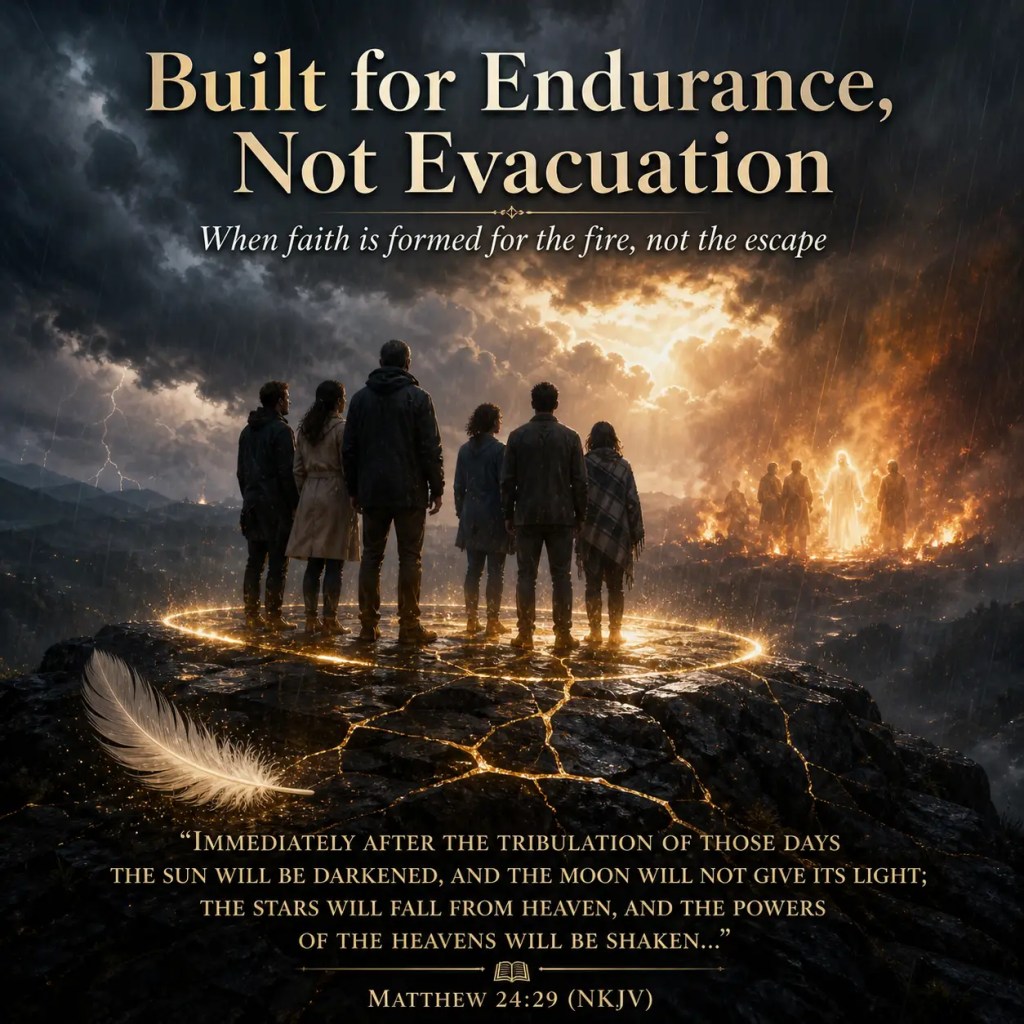
What happens to faith built on an exit strategy when the exit doesn’t come?
📖 “Immediately after the tribulation of those days the sun will be darkened, and the moon will not give its light; the stars will fall from heaven, and the powers of the heavens will be shaken… Then two men will be in the field: one will be taken and the other left.” — Matthew 24:29, 40 (NKJV)
―――――――――――――――
There is a conversation the Church needs to have — not to divide, not to dismiss — but to prepare. It’s a conversation about what we’re actually building when we build our faith, and whether what we’re building will hold when the pressure comes.
For generations, many sincere, Bible-believing Christians have been taught that before the great tribulation descends upon the earth, the Church will be removed — swept up in a rapture, sheltered from the storm, spared the furnace. It’s a beautiful hope. It’s also, I believe, one that deserves to be held gently and examined honestly, Scripture in hand.
🕯 The question isn’t merely theological. It’s pastoral. It’s personal. It’s urgent.
What happens to faith built on an exit strategy when the exit doesn’t come?
―――――――――――――――
📖 What Jesus Actually Said
Let’s begin where we must always begin: with the words of Jesus himself.
In Matthew 24, the disciples come to Him with questions about the end of the age. Jesus answers at length, describing false prophets, wars, famines, persecution, and cosmic disruption. He is not vague. He is not evasive. He is a Shepherd preparing His flock.
Then comes verse 29:
📖 “Immediately after the tribulation of those days…” — Matthew 24:29 (NKJV)
And just eleven verses later, still in the same discourse, still on the same mountain, still speaking to the same disciples:
📖 “Then two men will be in the field: one will be taken and the other left.” — Matthew 24:40 (NKJV)
The word “then” matters enormously. It doesn’t float free of context. It sits in direct sequence after verse 29’s “immediately after the tribulation.” To relocate this “taking” to a pre\-tribulation event requires reading against the plain sequence Jesus establishes. That is a significant hermeneutical step, and one that must be acknowledged honestly.
🪨 The Greek word translated “taken” here is παραλαμβάνω (paralambano) — meaning to receive alongside, to take with oneself, to accompany. This is not the same word used in 1 Thessalonians 4:17, where Paul describes the rapture using ἁρπάζω (harpazo) — to seize, to snatch away suddenly by force. These are two distinct words with two distinct meanings. If Jesus intended to describe the same catching-away event, He had the vocabulary to do so. The plain reading of Matthew 24 uses a different word — in a different sequence — after the tribulation has already occurred.
The plain reading of the text is clear: the gathering of the saints described here happens after the tribulation. Jesus doesn’t offer His disciples an exit strategy. He offers them something far more costly, and far more glorious — His presence through it.
―――――――――――――――
🌿 The Saints Don’t Disappear
Some have argued that because the word ekklesia — the Church — doesn’t appear by name after Revelation chapter 3, the Church must have been raptured before the tribulation events of later chapters unfold. It’s a thoughtful observation, but the conclusion doesn’t follow.
The saints are thoroughly present throughout the book of Revelation. They aren’t absent. They’re suffering. They’re overcoming. They’re being tested.
📖 “It was granted to him to make war with the saints and to overcome them.” — Revelation 13:7 (NKJV)
🪨 The word translated “saints” throughout Revelation is ἅγιοι (hagioi) — the holy ones, the set-apart ones. This is not a new category of believer invented after the Church was supposedly removed. These are the same people described throughout the New Testament as belonging to Christ. The body of Christ doesn’t vanish from the pages of Revelation; it simply loses the institutional label and is revealed in its truest identity — a people set apart, not swept away.
The visible institution of the Church as we know it today may indeed look unrecognisable under severe persecution; history already shows us this. A persecuted Church is not an absent Church. It is a Church refined, stripped of comfort, clinging to Christ alone.
This is not a people who have been evacuated. This is a people being purified.
📖 “These are the ones who come out of the great tribulation, and washed their robes and made them white in the blood of the Lamb.” — Revelation 7:14 (NKJV)
🪨 The phrase “great tribulation” in the original Greek is θλίψις μεγάλη (thlipsis megale) — literally, great pressure or crushing weight. The root θλίβω (thlibo) means to press, to squeeze, to compress under a heavy load. This is not a word of distance — it is a word of contact. These saints weren’t watching the tribulation from a safe remove. They were under its weight — and they came through it white-robed and washed in the blood of the Lamb. That is not the language of exemption. That is the language of ὑπομονή (hypomone) — endurance — which literally means to remain under. To stay. To not flee.
They didn’t skip the tribulation. They walked through it — and they emerged with white robes. That is the testimony of endurance, not evacuation.
―――――――――――――――
🔥 The Goshen Principle: Protected Within, Not Removed From
Here is what I believe with my whole heart: God’s protection doesn’t always look like removal. Sometimes it looks like Goshen.
When the plagues descended upon Egypt, the Israelites weren’t airlifted to safety. They remained in the land — but a distinction was made. The darkness that covered Egypt didn’t touch Goshen. The death that swept through Egypt passed over the doorposts marked with blood.
📖 “And in that day I will set apart the land of Goshen, in which My people dwell, that no swarms of flies shall be there.” — Exodus 8:22 (NKJV)
🪨 The Hebrew word translated “set apart” is הִפְלֵיתִי (hifleti) — from the root פָלָה (palah), meaning to be distinguished, to be made marvellous, to be separated by a divine act. It carries the sense of God Himself doing something extraordinary and visible to mark the difference between His people and the world around them. This isn’t quiet protection — it’s a declared distinction. God didn’t move His people out of Egypt. He drew a line around them within Egypt and said: this far, and no further. The same God draws that same line today.
The pattern of God throughout Scripture is not removal from the fire — it’s preservation within it. Shadrach, Meshach, and Abednego were thrown into the furnace, not spared from it. The fourth man appeared in the fire, not outside it.
Jesus himself, praying over His disciples on the eve of His crucifixion, said something that should settle deep into every heart:
📖 “I do not pray that You should take them out of the world, but that You should keep them from the evil one.” — John 17:15 (NKJV)
🪨 Jesus uses the word τηρέω (tereo) — translated “keep” — which means to guard carefully, to watch over with attentive care, to hold securely. It’s the same word used for keeping the commandments, for guarding treasure, for a sentinel standing watch. Jesus isn’t asking the Father for passive non-interference — He is asking for active, intentional, ongoing guardianship. Not removal. Not relocation. Guarding. This from the One who is Himself the Good Shepherd — the One who doesn’t run when the wolf comes, but stands between the flock and the threat.
Not out of. Keep them from. Presence within the storm. Protection through the trial. This is the heart of our Shepherd — not distance, but nearness. Not evacuation, but covenant.
―――――――――――――――
💔 The Pastoral Urgency
Pre-tribulation theology is held by many genuine, Spirit-filled believers, and I honour that sincerity. This isn’t an argument for argument’s sake. This is a pastoral concern that won’t let me be quiet.
A faith built around escape can, quietly and without intention, produce a spirituality oriented towards comfort, exemption, and the avoidance of suffering. When the pressure comes — and Jesus promised it would — and the exit doesn’t appear, the disillusionment can be catastrophic. Not just disappointment. Shipwreck.
The early Church had no exit strategy. They had a Shepherd. They had the Word. They had each other, and they had the Holy Spirit. They walked into arenas, into prisons, into exile — singing. Paul and Silas, feet in stocks at midnight, choosing worship in the darkness:
📖 “But at midnight Paul and Silas were praying and singing hymns to God, and the prisoners were listening to them.” — Acts 16:25 (NKJV)
🪨 The Greek word translated “singing hymns” is ὑμνέω (hymneo) — an active, ongoing verb. Paul and Silas weren’t remembering better days or quoting a worship song from memory in a moment of desperation. They were actively, intentionally, continuously singing praise — in chains, at midnight, in pain. This is ὑπομονή (hypomone) — endurance — in its most luminous form. Remaining under the weight, and choosing worship anyway.
They weren’t waiting to be removed from the suffering. They were worshipping through it — and the earth shook.
This is the kind of faith that endures. This is the faith we must build.
―――――――――――――――
🪨 Building for Endurance, Not Evacuation
This isn’t about living in fear of what is coming. It is about building wisely, honestly, and deeply — so that when the storm rises, we don’t crumble.
The New Testament word for endurance is ὑπομονή (hypomone) — from ὑπό (hypo, meaning under) and μένω (meno, meaning to remain, to abide). Together they form a picture of someone who stays under the weight rather than fleeing from it. This is not passive resignation — it is active, rooted, eyes-open faithfulness. It is the quality most consistently called for in the letters to the seven churches of Revelation. Not escape. Not evacuation. Remaining.
Endurance faith looks different to evacuation faith. It roots itself in the character of God, not the comfort of circumstances. It knows how to worship at midnight. It has learned to recognise the fourth man in the fire. It has sat with the Word long enough to trust the Shepherd’s voice when everything else goes dark.
🕊️ If the rapture comes before the tribulation — glory to God, what a mercy. If it doesn’t, I want a people who are ready. I want hearts so grounded in the love of Christ, so practised in prayer, so familiar with His voice, that tribulation cannot undo what grace has built.
We don’t prepare for the worst because we’ve lost hope. We prepare in hope, because we trust the One who holds the future — and because we love the people who are going to need a Church that didn’t run.
🌱 We must build for endurance, not evacuation.
―――――――――――――――
💡 Reflection
“You don’t have to have it all figured out to begin. Your story matters — even the parts that still hurt, even the chapters you’d rather skip. Take a moment with these questions and let the Holy Spirit lead you gently…”
If the tribulation came tomorrow and the exit didn’t appear, what would your faith look like? What is it currently built on? 🤔
Where have you experienced God’s “Goshen protection” — His preservation within a trial rather than removal from it? 🤔
Are you building a faith of endurance — one that knows how to worship at midnight? What does that look like in your daily life right now? 🤔
Where has the promise of escape — in any area of life — quietly kept you from developing the deep roots that only difficulty can grow? 🤔
What would it mean for your community, your family, or your ministry to be genuinely ready — not fearful, but prepared and deeply rooted? 🤔
―――――――――――――――
🎺 Affirmation
You are not called to a Christianity of exemption. You are called to a Christianity of overcoming. The One who walks with you in the fire is the same One who was with Paul and Silas at midnight, the same One who met Elijah in the wilderness, the same One who stood in the furnace with three faithful servants who simply would not bow. He hasn’t changed. He won’t leave you. The Shepherd doesn’t abandon the flock when the wolves close in — He lays down His life for the sheep.
🕊️ “And if this is your story too — even a fragment of it — know that you are not alone. God sees. God knows. God redeems.”
―――――――――――――――
🙌 Prayer
“Lord, I lay this story — all of it — at Your feet. The beautiful parts and the broken ones. Take it, and let it be of use…”
Father, we come before You not with fear, but with open hands and honest hearts. Forgive us for the times we have built our faith on comfort rather than covenant — on the hope of escape rather than the promise of Your presence. We don’t want a faith that crumbles when the exit doesn’t come. We want the faith of Shadrach, Meshach, and Abednego — the kind that says, “Our God is able to deliver us, but even if He doesn’t, we will not bow.” We want the faith of Paul and Silas — that finds a song in the darkest hour and dares to sing it out loud. Lord, make us endurance people. Root us deep. Anchor us in Your Word. Let us be the Church that doesn’t run — the Church that stands, worships, and overcomes. Let us be ready, not afraid. Prepared, not presumptuous. Held by You, whatever comes.
In Jesus’ Name, Amen.
―――――――――――――――
The Church has always been at her most beautiful not when she was comfortable, but when she was cornered — and chose Christ anyway. That is the inheritance we carry. That is the legacy we must pass on. Don’t build for the exit. Build for the long haul. Build for the midnight worship and the Goshen protection and the fourth-man-in-the-fire kind of faith. He is worth it. He is enough — not only if we escape, but especially if we don’t.
Reflections from readers
Be the first to share a reflection. 💛
New testimonies arrive as the journey unfolds. Subscribe to follow along — straight to your inbox. 🕊️