

The Backpack and the Dance
On being finally seen in your grief, and learning that dancing encumbered is still worship
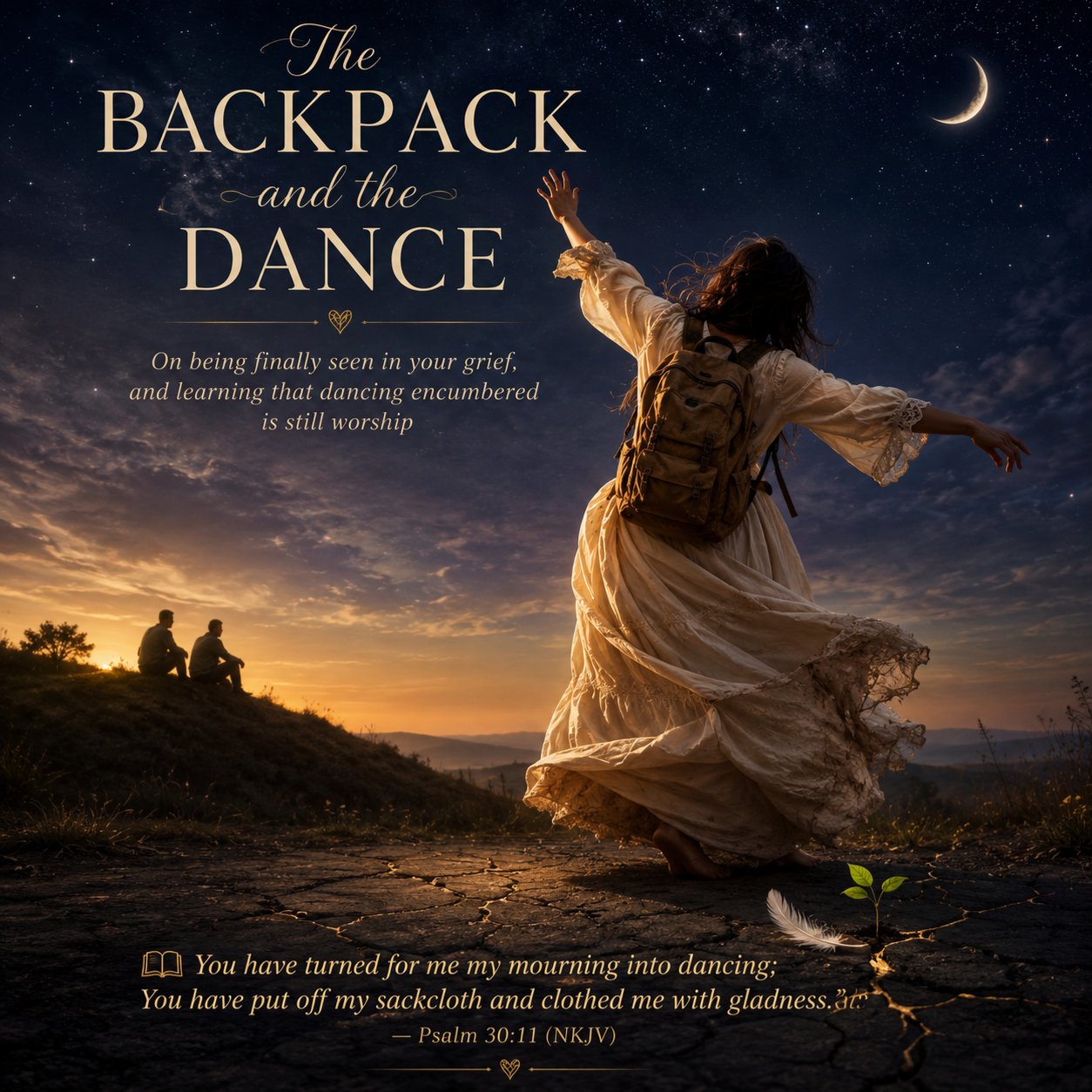
📖"You turned for me my mourning into dancing; You put off my sackcloth and clothed me with gladness."
I had a weird dream last night. In it, I was at an amusement park like Gold Reef City — vast rides towering over green spaces, the kind of place meant for joy and abandonment.
A friend from my Elijah House years was there — the one I'd walked through the alphabet schools small groups with. My boss and mentor was there too — the one who calls me out with love, who sees right through my attempts to outrun my grief with the next accomplishment. A childhood connection was there, now only present through screens and group chats, along with many more familiar faces.
We were together, they were in the crowd with me, yet I was alone.
The others wanted to ride. The joy rides called to them, glittering and enormous. I wanted to go, truly wanted to, yet something in me refused. I stayed back, watching them disappear into the thrill, watching them receive the joy I'd chosen not to take. The refusal cost me, yet I couldn't name why.
Later, at dinner, they showed videos of the rides they'd experienced, the laughter they'd lived, the joy I'd stepped away from. It was the evidence of missing out, and it broke something open in me.
I walked out of the restaurant and walked it off until I found myself at the edge of a cliff. The cliff wasn't as high as I'd feared. Only the height of a rooftop. I felt someone behind me, perhaps my husband, perhaps the weight of being questioned, of having to explain the inexplicable. Maybe I jumped to escape the questions that would follow.
When I jumped, I landed the way I used to as a little girl off the garage roof — safe, unbroken, my body remembering how to fall and remain whole. My backpack was still on my shoulders. My dress was very long, making movement difficult, constraining.
That's when I heard it, not with my ears, but in my spirit. The song rose up from somewhere deep within me: "You still reign & You're still God."
I began to dance. Even encumbered, even constrained by the weight I was carrying and the cloth that bound my movement, I danced. My body moved like nobody was watching. The backpack pulled at my shoulders. The long dress wrapped around my legs. Yet something in me had been released by the fall, by the song, by the voice of God speaking directly into my spirit in that tender hour between night and waking.
Then I noticed them, my husband and my boss, sitting together on a little hill to my left, watching me dance.
The moment I saw them, everything changed. My movement became self-conscious. My body went careful. The freedom I'd found — that wild, unguarded, grief-broken dancing — suddenly had an audience, so I stiffened. Even at home, even in worship, I dance more freely when I'm unnoticed, when I'm in the back where no one's eyes can find me. At church, at gatherings, the moment self-awareness arrives, the flow stops. I struggle to move freely when I know I'm being seen, even by eyes that love me, even by protectors who care.
The dream ended there, at that threshold of being watched. I woke.
There's so much grief living in my body right now. Three significant deaths in less than a year — now beloved Oom Leon's passing has cracked open all the losses I'd learned to swallow quietly, all the grief I was taught to carry without fussing, without stopping, without letting anyone know it was breaking me.
This week a question around the five love languages exposed something far deeper. When I was a child, my head was shoved under cold water for crying. For needing time, for wanting affirmations, for longing for touch, for simply existing as a small girl who needed love. In that moment of punishment, I made a vow — no, I made several vows — silent, desperate vows that have echoed through my entire life.
I vowed I would never cry again. I vowed I would never let anyone see me cry. I vowed I wouldn't need the things I was crying for. I decided I wouldn't need time, affirmations, touch, or love itself. I wouldn't need anything all but I wouldn't let others go without .I would give it all away, freely and fully, but I wouldn't let it touch me — I'd let it roll off like water on a duck's back. The capacity to receive real love when it arrived was drowned out, quite literally, in cold water.
The wounds kept multiplying though. As a teenager, a family friend showered me with affirmations, with words that made me feel seen and valued — followed by unwholesome touch. Touch that came disguised as care. Affirmations that were the bait before the harm. In that confusion, in that betrayal of trust by someone positioned as a protector, I learned something that carved deeper than the cold water ever could: affirmations come with strings attached. Touch is unsafe and confusing. Being seen is dangerous. Tenderness is the prelude to violation.
The wound wasn't just about time. It was about love itself — in every form, in every language. Words of affirmation?🤔 I learned those were lies meant to manipulate. Gifts?🤔 Strings attached. Touch?🤔 Unsafe. Service?🤔 Only if I could give it; receiving made me indebted and vulnerable. Presence?🤔 That's what I needed most, and that's what was withheld.
This is where the trap was set: I needed love desperately — all forms of it but asking for it, accepting it, letting it touch me — all of it brought pain. So I learned the only logical response a wounded child can learn: I stopped needing it. Or I tried to. I vowed myself out of love altogether so that love couldn't be used against me anymore.
Except the need doesn't disappear. It just goes underground. The hunger for affirmation, for presence, for someone to cherish me, for touch, for gifts that said "I was thinking of you" — it all remained, starving and silent in the dark places of my heart. Neither did the terror of receiving disappear. This became the double-bind made comprehensive: I was starving for love in every language, yet my nervous system had learned that accepting any of these was stepping back into the original wound. So I became incapable of receiving love in any form at all.
I learned a different language instead: acts of service. If I couldn't earn love by receiving it, perhaps I could earn safety by giving it. If I couldn't accept words of affirmation, perhaps I could become the kind of person who didn't need them — the useful one, the reliable one, the invisible one who asks for nothing and gives everything. If I couldn't earn time through crying, perhaps I could earn it through usefulness, through being helpful and reliable, invisible in the way that helps rather than hinders. It became my habitual way until it just became who I was.
The one who serves. The one who gives. The one who makes time for everyone else's needs whilst her own became smaller and smaller, folded away like a letter written but never sent. The one who speaks love in every language but struggles to receive it.
For four years I haven't missed a beat in my Encounter Groups and paint parties, moving them into my studio to hold them close, to pour out even when pouring out was costing me. Two weeks ago, I had to cancel for the first time — emotional overwhelm won the day. Someone showed up; he didn't see the message and came very late. I didn't turn him away because he needed to process something heavy. Even in my own breaking, I couldn't protect my own boundary. Even when I was collapsing, I was still the one holding space for his sorrow, still the one pouring out. I asked my regular to join a morning group, paused the evening gathering, so suddenly the rhythm I'd kept for four years was broken.
I'm still uncertain whether this will turn out to be one of the best decisions I've ever made.
The dream shows me something I've been living: I refuse the joy rides to stay useful. I carry the weight — the backpack, the grief, the decades of showing up — because being needed feels safer than being seen. My boss called me out on Wednesday for trying to outrun the ache with the next accomplishment. "What use would I be to them, to my family, to my Encounter Groups if I ended in burnout?🤔" I replied, "None."
None.
I said it plainly. I acknowledged it in that moment. Yet I don't stop. I can't stop. The moment the productivity ends, the moment the showing up pauses, I become worthless.
The dream is showing me what I've been running from — not just the grief itself, the weight of three deaths, the unearthing of all the grief before that. It's the terror of being still long enough for someone to notice I'm breaking. It's the [self-hatred] I recognise when I stop being productive, the love languages I speak fluently yet cannot receive when they're offered back to me. It's the loneliness of refusing the joy rides so that I can remain essential, remain needed, remain invisible in my usefulness.
After I got home from meeting with my mentor, it all came out sideways, almost as if being called out was permission to break. My body couldn't hold it anymore. Now I'm sick with a blocked nose, teary and itchy eyes — grief insisting on finding a way out, even when it's not flowing cleanly. I've heard Sandra’s phrase: "You wouldn't have to cry through your nose if you allowed yourself to cry freely." You would think after hearing that so many times, I would let myself cry freely.
The reality of it stops me: I'm unsure who has time to hold me in my sorrow, sit with me until the tears stop without me closing the tap. What if these tears keep flowing for hours if I let them?🤔 Who's got that much time to sit with me through that?🤔 Time, I've learnt, is very scarce, so I limit my tears. I shut them down time and again, but the emptiness and emotions don't go away. So I reach for busyness to drown them.
So I stay useful. I refuse the joy rides. I pour out for decades. I can't even maintain a boundary when I'm drowning. If I'm essential, if I'm the one showing up, the one who's got it together, the one who serves then no one will leave. No one wil reject what they've never fully seen.
Yet God's voice in that liminal space — between sleep and waking, between one grief and the next — says something utterly different. Not that my caution is wrong, the gift in it is that my dancing matters. That dancing encumbered is still worship. That the moment someone loves you enough to sit on a hill and watch you dance through your sorrow — truly witness you, truly stay — you're no longer quite as alone as you believed.
The song in my spirit says: "You still reign & You're still God." Not because I've earned it through decades of showing up. Not because I'm dancing freely or moving swiftly or hiding in the back anymore. Simply because He reigns, because He's still God, even in the small hours when grief wakes me up, when my nose is blocked with unshed tears, when I'm not sure if pausing was the right call, when the child in me is still learning that real love is safe, when the teenager in me is still unlearning that affirmations and touch come with strings attached, when the woman in me is still discovering that receiving love doesn't make me indebted or unsafe.
The dancing, encumbered as it was, was my yes to that truth.
God still speaks in the night hours — in the seasons between sleep and waking, in the moments when grief finally cracks you open enough to listen. He speaks in songs that rise up from your spirit, not in your ear. He calls you to dance even when you're carrying weight, even when the cloth binds your movement, even when you know someone's watching from a hill nearby.
The aloneness you've felt in the crowd, the joy rides you've refused to protect yourself from being noticed — these are patterns worth naming. The grief you've been taught to swallow quietly deserves to break open. The moment you see yourself truly seen — really watched, really witnessed by someone who loves you — that's not a moment to go careful. That's an invitation to keep dancing anyway.
You don't have to have it all figured out. You don't have to know yet whether pausing was the right call, or whether the backpack you've been carrying has made you stronger or just weaker. You don't have to believe yet that you have worth beyond what you produce, beyond who needs you, beyond the usefulness you've built your whole life around. You don't have to untangle affirmations from harm overnight, or learn to receive touch as safe in a single season, or discover that gifts can be given without strings. Sit with these questions gently, letting the Holy Spirit lead you deeper into the truth beneath the surface.
My story for His glory, changing the world 🌏 one 💔heart💖 at a time. — Patrizia
In this tender season between one loss and the next, God is not asking you to have it all figured out. He's not asking you to know yet whether pausing was the right call. He's not asking you to believe yet that you have worth beyond what you produce. What He's inviting you to do is sit with these ancient hungers for affirmation, for presence, for touch, for gifts, for time and begin to learn, slowly and with His gentleness, that these hungers were never meant to be silenced. They were meant to be satisfied by love that doesn't have strings attached. Rest in that truth, dear one. Rest in the arms of the One who still reigns, who's still God, who will never weaponise your need against you, who will never use tenderness as bait for harm. You're learning to dance again. Let Him watch.
- What joy rides have you refused because being needed felt safer than being seen?🤔
- When did you first learn that your worth lived in what you produce rather than who you are?🤔
- Who in your life might be sitting on a hill, waiting to truly witness you — not the performing version, the real, breaking, dancing, fully alive you?🤔
- What would it mean to let someone stay for the whole of your grief, not just the tidy parts?🤔
- If God says you're still worthy even when the productivity stops, where is that belief being tested in your life right now?🤔
You are worthy of being seen, fully and completely. Your dancing matters — encumbered or free. The grief you carry is not a weakness; it's a testimony to the depth of your love. You're learning, slowly and bravely, that being still is not the same as being useless. You're learning that real love doesn't walk away when you stop performing. You are learning that affirmations can be spoken without strings, that touch can be safe, that gifts can mean "I was thinking of you" without enslaving you, that presence is what you deserved all along and what you can finally receive. You are held. You are seen. You are enough.
Father, I bring You this grief I've carried alone. I bring You the vows I made as a frightened child under cold water, the deeper vows I made as a betrayed teenager learning that affection could be a disguise for harm. Vows that have shaped how I move through the world, how I give, how I refuse to receive. I'm so tired of being essential. I'm so afraid of being still. Teach me to dance even when I'm being watched. Teach me that Your love isn't conditional on my productivity, my usefulness, my showing up. Help me believe that someone can truly stay for the whole of my breaking. Help me untangle affirmations from manipulation, help me learn that touch can be safe again, help me receive words of affirmation without flinching, help me accept gifts as tokens of love rather than chains, help me be present with people without needing to earn my place through service. Help me receive the love languages I speak so fluently to others. Help me learn that grief itself is a form of worship, that tears are prayers, that pausing is sometimes the bravest thing I can do. You still reign, Lord. You're still God. Help me rest in that truth. In Jesus' Name, Amen.
Reflections from readers
Be the first to share a reflection. 💛
New testimonies arrive as the journey unfolds. Subscribe to follow along — straight to your inbox. 🕊️