

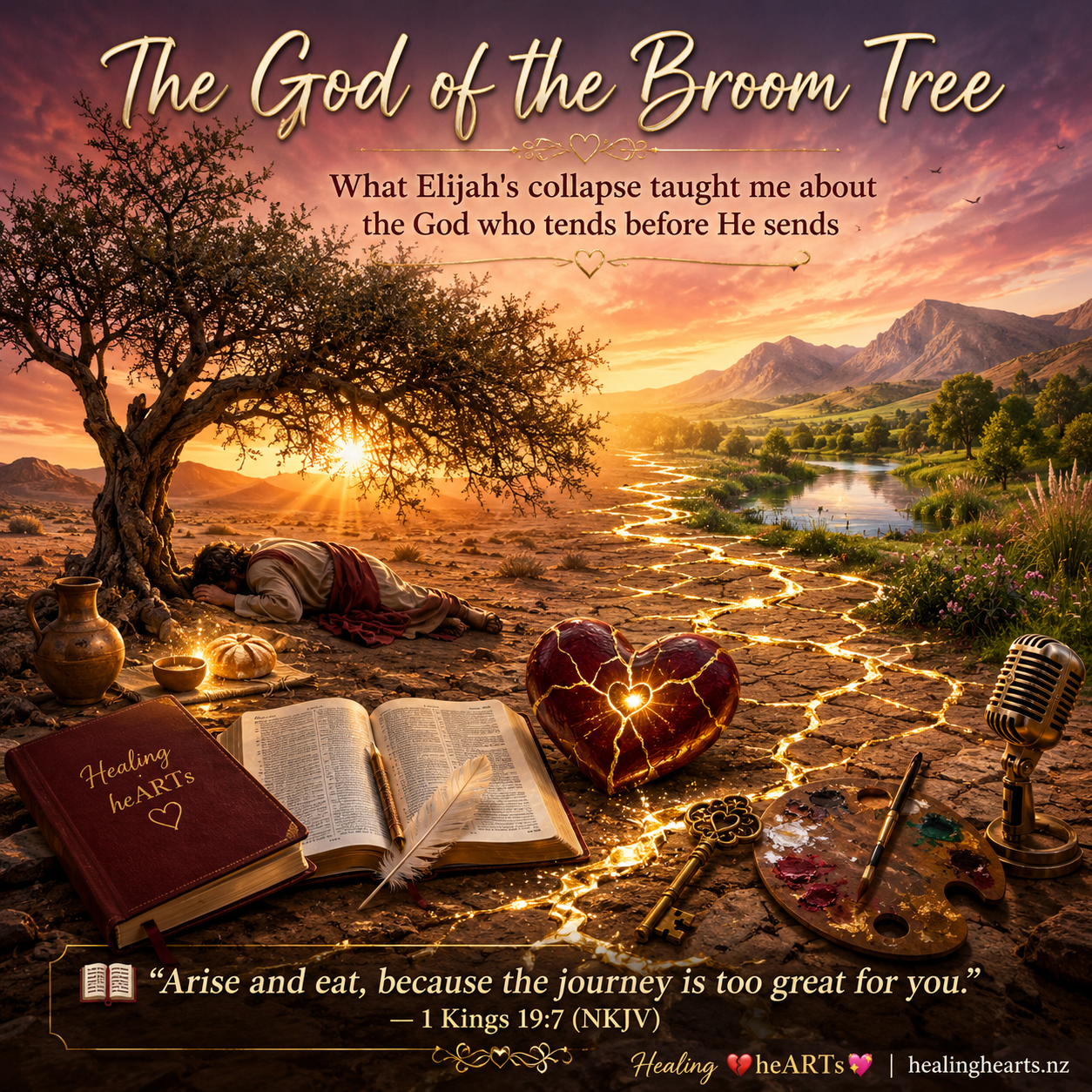
The God of the Broom Tree
What Elijah's collapse taught me about the God who tends before He sends
For decades, I kept going.
Serving, smiling, ticking every responsible box life required of me — while something deep inside quietly ran out of breath. On the outside, I looked capable. On the inside, my heart was exhausted. Not dramatically. Not in a way anyone would easily notice. Just... spent. Hollow in places I didn't know how to name.
I didn't sit under a broom tree. I sat in an ordinary life, in an ordinary home, wearing the ordinary face of a woman who had learned to breathe shallow and shrink small. I had slipped into survival mode so gradually that I didn't even realise I'd stopped truly living.
That's the thing with high-functioning depression. You're still showing up, going through the motions, whilst merely existing. It had been there all my life — I thought that's just who I was. Breathing, but not alive. Present, but not really there.
When I first acknowledged it to my dad, a few months after my breakdown, his response was: "What's wrong with you? You've always been like that." That single sentence quietly solidified the decision to push it all down and suffer in silence.
What I've learnt over the last ten years, since my breakdown is this: I can't continue pouring from an empty cup. I needed to learn the unforced rhythms of grace so I could pour from the overflow. There is no such thing as an unexpressed emotion. Pain that is buried alive stays alive — and it will morph and mutate until it eventually comes out sideways, like an erupting volcano.
God knew this long before I did. He has always been in the business of tending before sending.
Then one evening, my husband Clive came home, noticed something was off, and gently suggested I find a hobby.
That's where my restoration began. Not with a dramatic encounter. Not with a vision or a calling or a platform. With a gentle nudge — and eventually, a pencil in my hand.
***
When I read 1 Kings 19, I don't just see a prophet under a broom tree. I see myself.
Elijah had just experienced one of the most extraordinary moments in all of Scripture. Fire had fallen from heaven on Mount Carmel. The prophets of Baal had been defeated. God had shown up — unmistakably, powerfully, gloriously. It was a mountain-top victory by any measure.
Yet soon afterwards, Elijah fled. Jezebel's threat was enough to unravel him completely. He ran into the wilderness, sat down under a broom tree, and prayed to die.
📖 "It is enough! Now, Lord, take my life, for I am no better than my fathers!" — 1 Kings 19:4 (NKJV)
He wasn't being dramatic. He was done. The kind of done that lives not just in the mind but in the bones — in the body, in the spirit, in every quiet corner of the soul. The victory had cost him more than he knew he had. In the aftermath, the emotional and physical crash came hard.
What strikes me most is what God did not do.
He didn't rebuke Elijah. He didn't say, "What are you doing here? After everything I just did for you?" He didn't send a sermon or a strategy. He didn't point to the mountain-top and say, "Remember that? Pull yourself together."
He sent an angel.
📖 "Then as he lay and slept under a broom tree, suddenly an angel touched him, and said to him, 'Arise and eat.' Then he looked, and there by his head was a cake baked on coals, and a jar of water. So he ate and drank, and lay down again." — 1 Kings 19:5–6 (NKJV)
Sleep. Bread. Water. Rest. A gentle touch.
Then the angel came back a second time — because once wasn't enough — and said:
📖 "Arise and eat, because the journey is too great for you." — 1 Kings 19:7 (NKJV)
Not: the journey is over. Not: you've failed. Simply: the journey is too great for you in this condition. So eat. So rest. So let Me tend to you before we take another step.
That sentence contains more compassion than most of us allow ourselves to receive.
***
There is a reason we struggle to receive that compassion. Performance orientation runs deep in many of us. We have learned — through culture, through wound, through years of proving our worth — that stillness feels dangerous. That rest feels like falling behind. That stopping, even briefly, might reveal just how tired we truly are. For many, our earliest moments were filled with silence. Our primary caregivers were so busy earning a living that they were absent from meeting our emotional needs — and compassion became a foreign concept. In our wounding, some of us made a quiet vow: we wouldn't need it. We'd manage. We'd cope. We'd be fine. So we kept going. We kept serving. We kept smiling. Until we couldn't.
That vow left us stuck in the middle of a double-bind — the basic human need for compassion on one side, and the deep-seated determination never to appear needy on the other.
These vows made in childhood are quite powerful. They become the driving force behind all our reactions, our auto-pilot, the habitual ways we self-protect our hearts. Since they were erected by our own choices, God won't dismantle them without our permission.
Yet God, in His great mercy, allows our strongholds to become overloaded — so we can remember we were created for community. Not to perform for people, but to be truly known by them. Not to manage alone, but to be held.
The Good Shepherd knows this about His sheep.
📖 "He makes me lie down in green pastures." — Psalm 23:2 (NKJV)
He makes us. Not suggests. Not invites. Makes. Left to our own striving, many of us simply won't stop. We'll keep serving, keep producing, keep performing — until something stops us instead.
The body, in its wisdom, will eventually speak what the soul has been suppressing. Exhaustion that isn't honoured becomes illness. Grief that isn't tended becomes breakdown. The weight we keep pushing down doesn't disappear; it finds another way out. Pain that is buried alive stays alive — and it will morph and mutate until it eventually comes out sideways, like an erupting volcano.
I know this not as theory, but as testimony.
God's green pastures weren't a reward for my productivity. They were His mercy — His firm, loving insistence that I couldn't pour from an empty cup indefinitely. The Shepherd who lays us down in green pastures is the same God who sent an angel to Elijah with bread and water. He has always known that restoration must come before the road ahead.
***
He slowed me down. He allowed my breakdown. He led me into creativity — gently, quietly, one small step at a time. Through drawing, then painting, He began to open something in me that had long since closed. He used colour and canvas to reach the places where words couldn't go. He gave me a hobby and hid a healing inside it.
I needed to learn the unforced rhythms of grace so I could pour from the overflow — not from the dregs of a life run on empty.
📖 "Are you tired? Worn out? Burned out on religion? Come to me. Get away with me and you'll recover your life. I'll show you how to take a real rest. Walk with me and work with me — watch how I do it. Learn the unforced rhythms of grace." — Matthew 11:28–29 (The Message)
Looking back, I see it clearly now: God tended my whole person before He renewed my calling. He met my exhaustion with gentleness, not demands. He replenished before He redirected. He restored before He sent.
That is the pattern of 1 Kings 19. That is the pattern of Psalm 23. That is the pattern of grace.
The still small voice came later — at Horeb, the mountain of God. The renewed calling came later. The next assignment came later. First? Sleep. Bread. Water. Rest. "The journey is too great for you."
***
If you're reading this and your heart is quietly running out of strength, I want to say something gently but clearly: God sees you under your broom tree.
He isn't disappointed in your exhaustion. He isn't waiting for you to rally. He isn't measuring your worth by how quickly you get back on your feet. He is the God who sends angels with warm bread, who makes His sheep lie down in green pastures, who says arise and eat — not because you've earned it, but because you're beloved, and the journey ahead will require more than you currently have.
Profound spiritual discouragement is often deeply intertwined with physical exhaustion. God knows this. He made you. He tends the whole person — body, soul, and spirit — because He loves the whole person.
Rest isn't retreat. Rest isn't a lack of faith. Rest is often one of His most merciful gifts, given to restore us for the road ahead.
📖 "He gives power to the weak, and to those who have no might He increases strength." — Isaiah 40:29 (NKJV)
Let Him tend you. Let Him touch you. Let Him feed you before He sends you.
The still small voice is coming. The renewed calling is coming. The next step is coming.
First — arise and eat. 💛
Life Application: Today, identify one thing you've been pushing through that God may actually be inviting you to lay down — even briefly. It might be a commitment, a conversation, or simply the relentless inner pressure to keep performing. Choose one small act of rest — a walk, an early night, a creative moment, a quiet cup of tea — and receive it as a gift from your Heavenly Father, not a failure of productivity.
- When did you last allow yourself to simply rest without guilt? 🤔
- Is there an area of your life where God might be saying "the journey is too great for you" — and inviting you to receive His care rather than push through alone? 🤔
- Has your body ever spoken what your soul refused to say? What was it telling you? 🤔
- What small, gentle thing has God placed in your life recently that might carry a hidden restoration inside it? 🤔
I am not failing when I rest — I am being tended by a faithful God. He sees my exhaustion and He is not disappointed in me. He makes me lie down in green pastures because He loves me, not because I have failed. He is the God who sends angels with bread and says, arise — and that is enough.
Lord, You are the God who tends before You send. You are the Good Shepherd who makes me lie down — even when my performance orientation would keep me on my feet until I fall. You see the exhaustion beneath the capable face, the emptiness beneath the faithful smile. Today I bring You my broom tree — the place where I've quietly run out of strength. I receive Your gentle touch. I receive the bread and the water of Your grace. I receive rest without guilt, because You have called it good. Restore me, Father — body, soul, and spirit — and when the still small voice comes, I will be ready to hear it. In Jesus' Name, Amen.
Reflections from readers
Be the first to share a reflection. 💛
New testimonies arrive as the journey unfolds. Subscribe to follow along — straight to your inbox. 🕊️