

The Silence That Taught Me to Speak
How generational loneliness became the fire to build something different
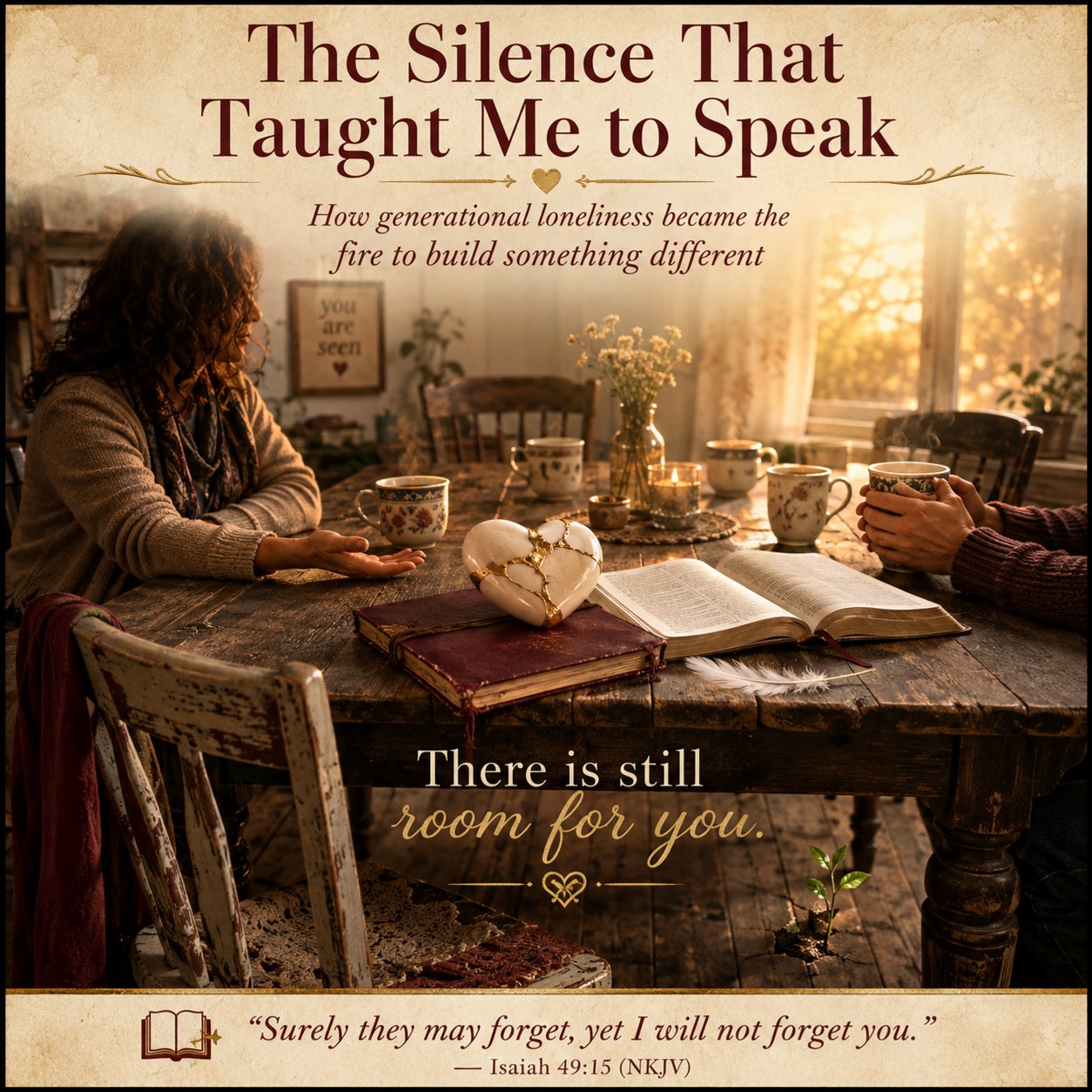
📖Can a woman forget her nursing child, and not have compassion on the son of her womb? Surely they may forget, yet I will not forget you.
I learned early that suffering happens in silence.
Not in quiet, contemplative silence — the kind that holds you gently. Rather, the kind where hard things occur behind closed doors and you learn to keep your breaking private. Where grief is something you manage alone. Where no one asks how you're really doing because the answer might require them to stay, and staying is inconvenient.
That was home.
Then I spent thirty years in church, surrounded by hundreds of people who knew my name, and I discovered something that still catches me off guard: the silence followed me. It just wore a different dress.
I can count on one hand the number of times someone from a congregation actually showed up when life shattered. Not sent a card. Not said "praying for you" on a Sunday morning. Actually showed up. Sat with me. Called back. Came by after the dust settled, not just on the day of the funeral when everyone gathers, but three months later when the real ache was still fresh and I was finally alone enough to feel it.
That handful of times is humbling and heartbreaking because it means I can count them. I should not be able to count them.
Over the past year — three deaths in less than a year — I've watched that childhood silence repeat itself at an almost unbearable volume. The silence from people who said they cared. The silence from church friends who've known me for years. The silence of the crowd, which turns out to be the loudest silence of all.
Grief has a way of clearing the room. It reveals who actually stays and who only gathers when the gathering is easy. When there's coffee and worship and a sermon that makes everyone feel inspired. Grief doesn't inspire anyone — it inconveniences them. It requires something. It demands presence. So the room empties.
And you're left sitting there, surrounded by the echoes of hundreds, and wondering: Did they ever actually see me? I'm learning the answer now. And it's more complicated than I thought.
Here's what I've realised: modern churches have become so vast, so structured, so dependent on scheduling that genuine friendship has become nearly impossible within them. You know hundreds of people, and yet if you want to see them after the service, you have to arrange it. Plan it. Schedule it weeks in advance. That's not friendship. That's coordination.
Real friendship doesn't require an appointment. It shows up uninvited. It calls mid-week. It continues when you're not in a pew. It lives in spontaneity and intimacy and the kind of knowing that can only come from doing actual life together, not just gathering for an hour.
So perhaps the people I counted on weren't failing me. Perhaps — and this is harder to hold — the very system we were all part of made real friendship nearly impossible. We weren't friends. We were proximate. We were gathered. We occupied the same space once a week.
But friendship that only exists around church gatherings isn't friendship at all. It's an illusion of connection without the substance of it.
Here's the truth I'm holding now, and it's fundamental: Silence is a choice.
Every time someone knows you're grieving and doesn't call, that's a choice. Every time you sit in church on a Sunday after a funeral and not one person asks how you actually are, that's a choice. Every time someone says "let me know if you need anything" and doesn't follow up when you're too broken to ask — that's a choice.
I don't always know why people make that choice. Sometimes it's fear — they don't know what to say. Sometimes it's emotional immaturity — they've never learned how to sit with sorrow. Sometimes it's their own unhealed wounds rising up, making them unable to witness yours. Sometimes it's simply the limit of human frailty — they're overwhelmed with their own lives and can't reach beyond themselves.
Whatever the reason, the choice remains a choice. And whatever the explanation, the grieving person still experiences the absence. That's what I'm holding: not judgment of their hearts, which I cannot fully know, but clarity about the impact. The absence is real. The silence reverberates. The breaking happens alone, regardless of the reasons why.
I stopped blaming them some time ago. Not because they don't deserve accountability, but because blame keeps me small. It keeps me looking backward at people who failed me instead of looking forward at the people who are still waiting for someone to finally stay — regardless of their reasons for not knowing how.
I've been reading John 11 differently lately — the story of Jesus at Lazarus's tomb. "Jesus wept."
Here's what strikes me: He knew. He knew that in moments, Lazarus would walk out of that tomb alive. Resurrection was minutes away. And yet — Jesus wept.
Not because He didn't know what was coming. Not because He doubted God's power. He wept knowing resurrection was imminent. That changes everything.
It means grief is real even when hope is certain. It means entering someone's sorrow doesn't require you to deny God's faithfulness. It means sitting with Mary and Martha in their devastation — their genuine devastation — mattered as much as the miracle that followed.
Resurrection knowledge does not make grief irrelevant.
Jesus came. He sat. He let Himself be moved by their pain. He didn't bypass their breaking with theology. He entered it. He wept in it.
"See how he loved him."
That's what the witnesses said. Not because of the miracle, but because they saw someone who loved deeply enough to grieve fully, even whilst holding hope. That's what love looks like.
The Holy Spirit has been teaching me something in the midst of this accumulating loss: Healing doesn't happen in silence.
Scripture tells us why: "Confess your sins to one another, and pray for one another, that you may be healed." (James 5:16, NKJV)
Notice what's embedded in that command: healing is bound up with confession. Confession requires breaking silence. Confession requires witness. You cannot be healed alone because healing, by its very nature, requires someone to hear you.
That's why silence is so devastating. It doesn't just feel lonely — it actually prevents healing. It keeps wounds sealed off from the light. It denies the very mechanism God designed for restoration.
Real healing happens when someone sees you breaking and stays anyway. When they call back. When they show up three months later. When they ask the hard questions and listen to the hard answers. When they sit with you in the dark and don't rush you toward the light. When they hear your confession — of grief, of pain, of doubt, of anger — and hold it with you without flinching.
That's when broken things become beautiful. That's when kintsugi actually happens — not when you hide the cracks, but when you invite someone to sit with you whilst you're broken, and together you let the Master Healer make something beautiful from what's shattered.
This is why I'm building Healing 💔heARTs💖. Not because I'm angry at the church — though I grieve what it could have been. Not because I'm trying to replace community — but because I know what it costs when community fails you. I know the shape of that abandonment. I know what it sounds like when a room full of believers chooses not to hear your breaking.
And I refuse to let another person sit alone in theirs.
The table I'm building is the table that was never set for me.
It's not scheduled. It's not coordinated around a building or a programme. It's a place where grief is welcomed, not managed. Where your breaking doesn't inconvenience anyone because we've all been broken — we're all learning to be restored. Where showing up isn't optional. Where three months after your loss, someone still calls. Where you don't have to ask for help; we're already at your door.
Where silence — the kind that abandons — is not allowed. Instead, there's the kind of silence that holds you. The silence of sitting together in shared sorrow. The silence where you don't have to perform healing or pretend you're fine. The silence that says: I'm here. I'm not leaving. Your breaking matters to me.
This isn't hypothetical for me.
I have a friend with ME — a condition that has stolen years of her life, that leaves her devastated by the limitations it imposes. For four years, I've been visiting her. Prayer ministry intercession became weekly ministry, shifted back to monthly as life demanded. The rhythm changed, but the commitment didn't.
Yesterday, I sat with her for an hour and a half whilst she sobbed.
Not fixing anything. Not offering solutions. Simply there. My presence the only thing that mattered.
And what she said — what she said whilst tears soaked through my shoulder — broke me open:
"You're the only one checking in on me. You're the only one visiting."
Four years. And she's the only one who knows she matters enough to show up.
I'm still holding that. Still sitting in the weight of it.
That's when I understood something visceral: This table already exists. It's not something I'm dreaming into being. It's something I'm already living, one person at a time. One friend. One sobbing hour that happened yesterday. One commitment that refuses to break.
This is what the table looks like.
I think about the people who will sit at that table — and I'm thinking of her too.
Some of them are carrying generational silence — like I do. Some of them learned in their families that suffering is private, that you don't burden others, that you manage alone. Some of them sat in churches like mine and discovered that proximity isn't the same as belonging. All of them have counted on one hand the number of people who actually stayed.
They're carrying three deaths. Or one that broke them open. Or a slow grief that no one noticed because it doesn't have a funeral date. Or an invisible illness that's stolen years, and they're the only ones who know it.
When they come to the table, they won't be coming because they've found a perfect community. They'll come because they're tired of sitting alone in crowds. They'll come because they've finally admitted: I need to be held through this.
And when they arrive — grief-worn and careful and half-expecting the silence to follow them there too — they'll find instead a circle of people who know exactly what it costs to break alone.
People who chose to say no to that pattern. People who refuse to let friendship exist only within a building or a schedule. People like my friend, who will finally — finally — know that her breaking is not a burden to those who love her. That showing up is not optional. That she matters enough to be remembered, visited, held.
I'm no longer waiting for the church to become what it was meant to be — though I pray it does.
Instead, I'm building what I longed to find. One table. One person. One circle of people who refuse to let each other sit alone.
Because I know what that silence costs.
I've paid that price in my own body, my own heart, my own early morning hours wondering if anyone would ever truly see me.
The answer is yes. They do. He does.
And now, with God's hand shaping this work, I'm creating a place where every person who walks through the door knows: You have been seen. You have been chosen. You will not sit alone in your breaking.
And now, beloved — I want you to know: the silence was never about you.
It was never because you weren't worth staying for. It was never because your grief was too much, your questions too hard, your breaking too inconvenient. It was the failure of a system that taught people to gather without truly knowing one another. It was the breakdown of genuine friendship, disguised as community.
That's not your burden to carry.
But the table you're building? That is yours. And it's holy work.
Every person who sits there and finally, finally feels held — that's your hand breaking the silence. That's the Holy Spirit moving through your refusal to abandon. That's resurrection happening at a wooden table over tea, as it has always happened in the Kingdom: through presence, through staying, through the fierce and tender love of one person saying to another:
I see you. I'm here. You do not sit alone.
That's everything.
My story for His glory, changing the world🌏 one 💔heart💖 at a time. — Patrizia
- In what ways did you learn — early or repeatedly — that suffering should be private, that breaking is something you manage alone? 🤔
- Where have you experienced the silence of a crowd — gathered around you but not truly present to your pain? 🤔
- What would it look like to grieve differently if you knew, without doubt, that someone would stay? 🤔
- Who broke that silence for you, and what did their presence actually do to your healing? 🤔
- What does your table need to offer to the people who arrive carrying the same generational silence you're breaking? 🤔
You were never meant to suffer alone. The silence you learned in childhood, the abandonment you've endured as an adult — these are not reflections of your worthiness or your faith. They are wounds. And wounds, when held in the presence of Christ the Master Healer and witnessed by true community, become the very places where resurrection happens. Your breaking has not disqualified you; it's positioned you to create sacred space where Christ does His healing work through the presence of His people. Your fierce determination to build a table where no person sits alone — that is not anger dressed up as ministry. That is love dressed up as revolution. You belong. You have always belonged. And the table you're building belongs to you too.
Holy Spirit, meet me in this grief that feels endless. Meet me in the silence that still echoes from my childhood, from my losses, from years in crowds where I was never truly known. Heal the places in me that learned to suffer alone, that believed breaking was something I should manage privately, that accepted silence as the cost of belonging. Forgive me for the times I've been silent when someone else was breaking. Open my eyes to see suffering I've walked past. Soften my heart so that I can be the presence others desperately need. Most of all, Father — thank You. Thank You for not forgetting me, even when everyone else did. Thank You for staying through every breaking, every loss, every year when the silence felt deafening. Thank You that my grief is not wasted, that my pain is being transformed into purpose, that the table I'm building is an offering of the healing I've received from You. Help me build it faithfully. Help me stay. Help me see every person who arrives broken and overwhelmed and wondering if anyone will actually care — and help me show them what it means to be held by the presence of Christ through the presence of His people. In Jesus' Name, Amen.
Reflections from readers
Be the first to share a reflection. 💛
New testimonies arrive as the journey unfolds. Subscribe to follow along — straight to your inbox. 🕊️