

When Grief Wears a Mask of Service
On loving someone through their guarded heart, and learning to release what we cannot carry for them
📖"Jesus wept."
There's a particular ache that lives in the space between what you see and what someone won't let you touch. I've been sitting with it all day — these words echoing: "I don't understand it. My mum died, my dad died, just another day for me. Maybe I'm weird."
I know that voice. I've been that voice.
Not weird. Surviving. There's a difference, though I think sometimes the person doing the surviving doesn't know it yet — because I didn't know it either. A lifetime of quietly pushing loss aside as "just another day." The deaths that stack up like cards you just don't look at. The compartments you lock so carefully you forget which ones are sealed. The numbness that feels like strength until one day you realise it's been the only thing keeping you upright.
I watched his eyes yesterday morning — just for a moment, like light breaking through clouds — and I saw it. The grief. The terrible, patient grief that's been warehoused somewhere beneath all the leadership, all the wisdom, all the strategic thinking and the care he pours into others. Then, just as quickly, the cloud rolled back in. The guardedness. The pivot to safer ground.
It was like looking into a mirror of a lifetime.
My heart cracked a little, because I recognised something in that moment: I didn't ask the right questions. I didn't create the safety. But the harder truth underneath that is this: I couldn't create the safety I've never fully stepped into myself. How can you invite someone into vulnerability when you're still learning to breathe through your own? How can you ask the tender questions when you've spent a lifetime believing that tender questions are luxuries you can't afford?
The voice that says "just another day" doesn't come from callousness. It comes from the necessity of surviving. It's the voice of someone who learned early that grief is too heavy to carry, so you leave it behind. Over and over. Again and again. Until you don't even notice you're doing it anymore.
The Holy Spirit whispers gently here, though — not with condemnation, but with such tender recognition: You are not responsible for his grief. You are only responsible for your love. And you're learning to love from a place that's still being healed.
That matters. That's honest.
Yet there's a paradox I'm learning — still learning, even now: bearing burdens doesn't mean carrying them alone for someone who won't let go. Sometimes love looks like offering the space, and sometimes it looks like stepping back when the door closes. Sometimes it looks like being honest about your own limitations.
The truth underneath this is tender: This man has given so much of himself to others that there's nothing left for his own breaking. It's the vulnerability of the servant, the shepherd who's forgotten that even shepherds need tending. His superstition about grief — that it's "just another day" — isn't cruelty or coldness. It's a coping mechanism that's become so familiar it feels like identity.
I know because I wore it too. For decades. The compounded losses, all the pushing down, all the compartmentalising — it becomes a volcano inside you, waiting for the pressure to release. Except sometimes the pressure just keeps building, and you keep saying "just another day," and one morning you wake up wondering who you are beneath all that survival.
I think what I'm grieving right now isn't just his grief. It's the recognition that I've been exactly where he is. Still am in some ways — learning to unlearn the numbness. Learning to let the losses matter. Learning that the "just another day" was never strength; it was just... survival. And there's a difference between surviving and being alive.
There's another layer to this that I'm sitting with, too. The colleague who got offended when I spoke of God's healing power — I can see now how the words landed like correction instead of invitation. God can and will heal your depression and body. The theology is true. The timing, perhaps, wasn't. I think I spoke from a place of my own healing breakthrough, forgetting that not everyone has been on the same journey yet. Not everyone has had the gift of watching their own broken places become beautiful again.
I forgot what it felt like to be where he is — still numb, still defended, still believing that facing the pain might break you permanently.
The fear underneath all of this is old and familiar: I've been here before. I tried. He shut down. Silence for a year. What if I repeat it? What if my attempt to love pushes him further away? What if my speaking truth — even in gentleness — becomes the reason the door closes again?
These are legitimate fears, born of real loss. They're also fears I'm learning to carry differently now, because I've learned that the volcano inside me has to release eventually. It's not a question of if — it's only a question of when, and with whom, and how safely.
The Holy Spirit invites me into something different this time. Not passivity. Not silence. Not the suppression of truth. Rather, a posture of humble availability — continuing to show up, continuing to love, but releasing the outcome to God. Continuing to speak truth, but seasoning it with more time, more listening, more permission for him to move at his own pace.
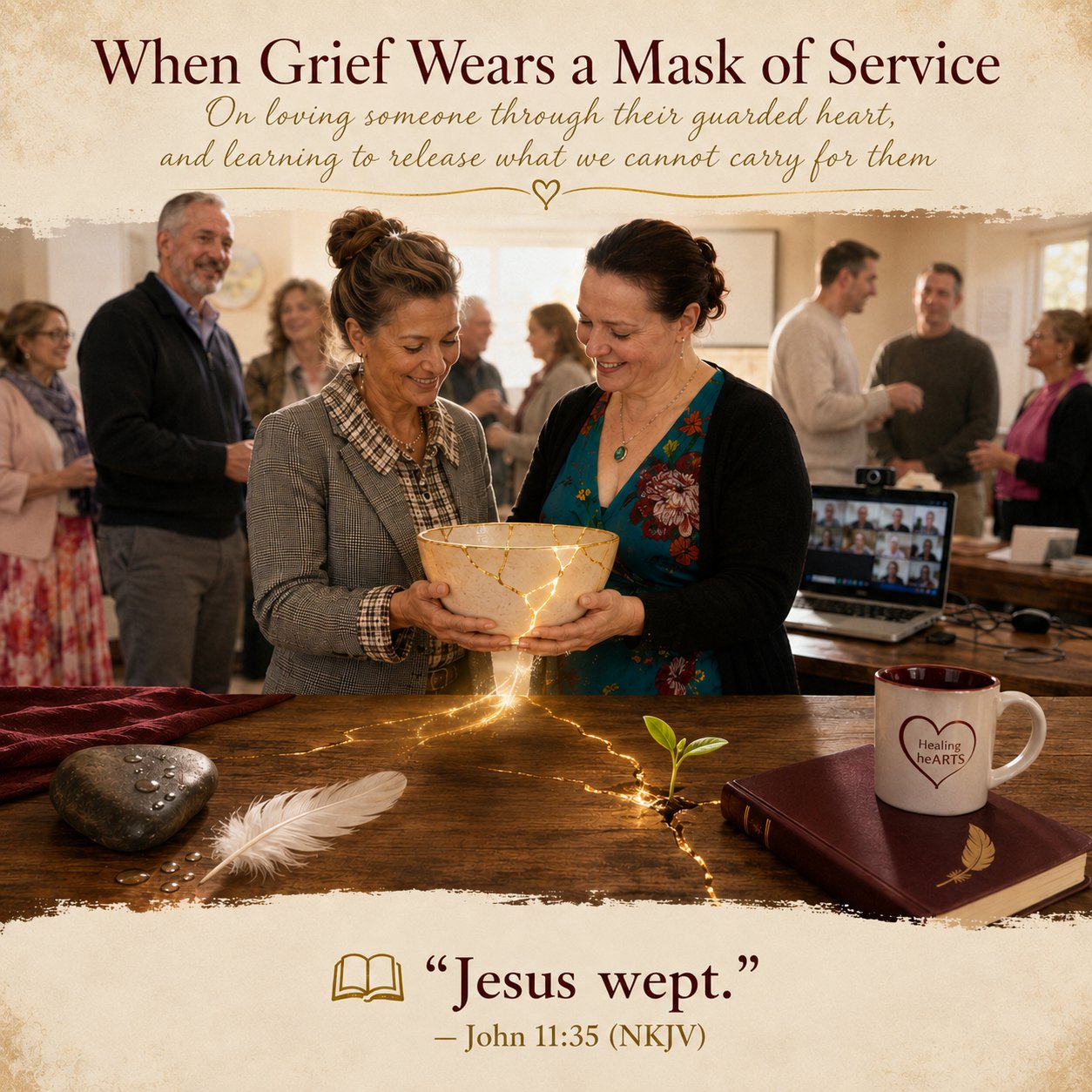
The gold in the broken pottery isn't added by force. It's poured into the cracks with intention, but gently. The vessel doesn't control how the light hits the gold — it simply remains open. I'm learning to be that kind of vessel. Still cracked. Still healing. Still holding more gold than I realised was possible.
My story for His glory, changing the world🌏 one 💔heart💖 at a time. — Patrizia
I've learned that there's a quiet peace that comes when I finally acknowledge what I cannot do, and lean fully into what I can. I can love. I can show up. I can speak truth gently. I can remain faithful through confusion. I can release him to God's hands, which are far more capable than mine. The volcano inside him will find its release. Mine too. My job isn't to control either of them. My job is to be the tender, still-healing presence that reminds him — when he's ready — that he doesn't have to carry it alone. Just as I'm learning I don't have to carry mine alone either. The gold is finding all the cracks. In him. In me. In both of us together, if he'll let it.
- What would it look like to love this leader *and myself* without needing either of us to receive the love as I intend it?
- Where in my own heart am I still carrying the "just another day" — and what would it cost to finally let those losses matter?
- What does "humble availability" mean in my specific relationship with him — how might I show up differently when I'm showing up from my own still-healing places?
- If the door closes again, what would it mean about my love, my faithfulness, and my worthiness — especially now that I understand his numbness from the inside?
- How is God inviting me to tend my own grief in this situation, not as separate from my love for him, but as part of it?
I am not the Holy Spirit. I was never meant to be. I'm a woman who's spent a lifetime learning to survive, and I'm now — slowly, courageously — learning to live. That's my real offering to him: not answers, not even perfect love, but the quiet testimony of someone who's walked through the volcano and found God waiting on the other side. My own healing is speaking volumes, even when I'm not saying anything at all. My brokenness, held in His hands, is more powerful than any perfect words could ever be.
Father, I'm bringing this man before You — this leader, this shepherd with unseen grief, this vault of compounded loss he's carried as if it were ordinary. Heal what he won't let me touch. Soften what's hardened in him. Give him permission to grieve, in Your presence and in Your time. And hold me, Lord. I'm confused about whether I've loved well. I'm afraid of repeating old patterns. I'm uncertain about my next step. Help me to love without needing to control the outcome. Give me wisdom to know when to speak and when to remain silent. Teach me the difference between bearing burdens and carrying them for someone who won't set them down. Something deeper than that, though: heal my own "just another days." The losses I've never let matter. The volcano I've been standing on my whole life. Give me courage to grieve — not just for him, but for myself. Let the gold seep into my own broken places. Help me understand that feeling the grief doesn't mean I'll break; it means I'm finally coming alive. Show me how to love him back to life without losing myself in the process. Show me how to be a mirror of Your grace: patient, truthful, present, willing to wait — *and* willing to let my own healing speak its own language. In Jesus' Name, Amen.
Reflections from readers
Be the first to share a reflection. 💛
New testimonies arrive as the journey unfolds. Subscribe to follow along — straight to your inbox. 🕊️