

You Are Safe Here
What healing looks like when the right people finally arrive
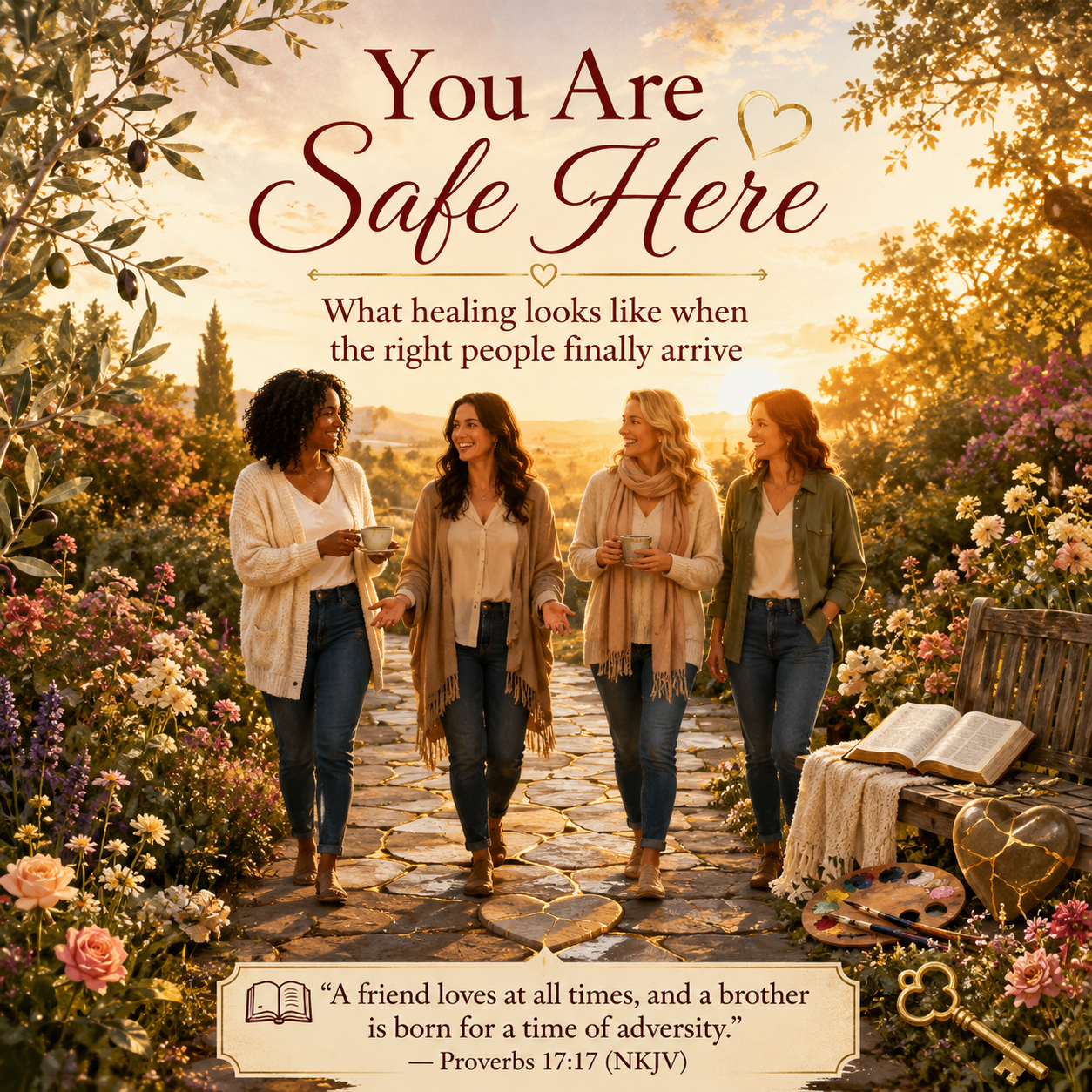
📖📖 "A friend loves at all times, and a brother is born for a time of adversity."
There is a kind of ache that doesn't have a name at first.
It's the ache of someone who has learned — through years of careful, costly lessons — that love has strings attached, that belonging comes with conditions, and that showing too much of yourself is simply too great a risk. It's not cynicism. It's not unfaith. It's the honest language of a nervous system that has been trained by experience.
I know this ache from the inside.
For much of my life, I believed that relationships required me to earn my place in them. I thought I had to be useful, easy to manage, pleasant to be around, and strong enough never to need too much. If I made a mistake, I braced for the leaving. If someone was upset, I instinctively reached for the responsibility. Those beliefs didn't arrive from nowhere — they were shaped in the environments of my earliest years, reinforced in seasons of church hurt, and sealed by the quiet devastation of betrayal from people I had trusted deeply.
I wasn't loved where I was. I was loved for what I could provide.
The Hebrew word at the root of Proverbs 17:17 is 'ahab — to love, to give affection, to breathe toward someone with warmth. It's a love without transaction, without record-keeping, without the door waiting to close. A friend who loves at all times doesn't mean a friend who never wounds you. It means a friend who stays present in the season when most others leave. For those of us whose earliest experiences taught us that people leave — that everyone eventually leaves — encountering this kind of love for the first time can feel more disorienting than relief.
When I began to meet safe people, my first response wasn't gratitude.
It was suspicion.
Not because anything was wrong with them — but because everything was right with them, and right felt foreign. They could hold frustration without raising their voice. They disagreed with me without withdrawing from me. They said I'm sorry without being prompted. They stayed after seeing me cry, after seeing me messy, after seeing me wrong. Somewhere deep in my nervous system, all of that consistency and kindness registered as suspicious. I kept waiting for the condition to reveal itself. I kept waiting for the cost.
📖 "God sets the solitary in families; He brings out those who are bound into prosperity." — Psalm 68:6 (NKJV)
This is what trauma does that nobody warns you about. It doesn't just wound you — it teaches you to distrust the healing. It convinces you that safe people don't exist, simply because you haven't experienced enough of them. Even when they arrive, your heart hangs back at the threshold, not because it doesn't want to enter, but because it genuinely cannot believe the door is real.
I've sat with enough broken-hearted people in Encounter Groups to know I am not alone in this. The one who flinches at kindness because kindness has always come before the knife. The one who deflects compliments as flattery because compliments have always come before the abuse. The one who overshares then isolates, testing whether someone will stay. The one who quietly dismantles every healthy relationship before it can dismantle them. These are not character flaws. These are survival strategies — brilliant, creative adaptations to environments that were never safe. The problem is that we carry them long after we've left those environments.
Healing, I have come to understand, doesn't happen in isolation. It happens in the presence of safe people.
📖 "Two are better than one, because they have a good reward for their labour. For if they fall, one will lift up his companion." — Ecclesiastes 4:9–10 (NKJV)
Safe people are not people who never hurt you. They are people who, when they do, take responsibility. They don't weaponise your vulnerabilities or keep invisible score. They don't make you earn what should be freely given. They allow you to breathe — to have feelings without those feelings being used against you, to express a need without it being classified as weakness. They apologise. They stay. They celebrate the tiny victories that no one else even knew to watch for.
Quietly, gently, moment by moment, they teach your nervous system something it never learned before.
Not everyone will hurt you.
Not everyone will leave.
Not everyone requires you to become someone else to be loved.
I remember the first time someone held space for me without trying to fix me, without shifting the conversation to themselves, without making me feel that my pain was an inconvenience. It was such a small thing — a cup of tea, a quiet room, someone who just stayed. I didn't have words for what it was, but something in me — something very old and very tired — exhaled.
That is what safe people do. They give your body permission to stop bracing.
📖 "Bear one another's burdens, and so fulfil the law of Christ." — Galatians 6:2 (NKJV)
We were never designed to carry alone what was meant to be carried together. The kintsugi pottery that has come to mean so much to me — broken pieces held together with gold — that image only works because something outside the vessel touches the fracture and stays. Gold doesn't fill gaps by itself. It has to be pressed in by patient, purposeful hands.
Safe people are those hands.
Safe people, with all their ordinary imperfections and faithful presence, are among the most beautiful demonstrations of God's heart this side of heaven.
The right people won't ask you to shrink or perform or hide in order to belong. They will remind you — through their actions, long before their words — that you were always worthy of love. Long before you learned how to survive. Long before you knew how to manage yourself into being acceptable.
You were loved before you were useful. That is the gospel.
- Have I been expecting safe people to behave like unsafe people because that is all I have known? 🤔
- Which survival strategies have protected me in the past but are now preventing deeper healing? 🤔
- Who has quietly demonstrated God's faithful love to me through their consistent presence? 🤔
- How is Jesus inviting me to receive love without feeling I must earn it? 🤔
- In what practical ways can I become a safer person for someone else this week? 🤔
- Think of someone in your life who has felt genuinely safe — what did that safety feel like in your body, and what did it make possible for you? 🤔
- Have you ever found yourself waiting for safe people to reveal their hidden cost? What old experience might that watchfulness be protecting you from? 🤔
- In what area of your life is God gently asking you to open the door to connection you've been keeping shut? 🤔
- Who in your life might be needing you to be a safe person for them right now — and what's one small way you could offer that? 🤔
I am deeply loved by God — not because of what I do, but because of who I am in Christ. My heart is learning that love can be safe, relationships can be faithful, and healing can happen in the company of people who reflect the steadfast love of Jesus. I am allowed to choose the people who are good for my healing. I no longer have to live braced for abandonment, for the Lord is surrounding me with His presence and leading me into relationships where grace, truth, and faithfulness flourish. I am safe enough to be seen. I am worthy of people who stay. God is sending the right ones. I will let them in.
Today, notice where you feel safe — in your body, in a conversation, in a room — and let yourself linger there a little longer than usual. If safe people are already near you, let them know, even in the simplest of ways, that they matter to you. If you're still longing for that safety, take one small, brave step toward it: say yes to the invitation, reply to the message, accept the cup of tea. Healing rarely arrives in a single moment — it arrives one safe interaction at a time.
Take your journal or a canvas and paint, sketch, or write what safety feels like to you — not what it looks like, but what it feels like. Is it a colour? A texture? A sound? A temperature? Let your creative self speak the language your nervous system knows before your mind does. As you create, offer it as a prayer: Lord, teach me to recognise safety when it arrives. And help me to become it for others.
Heavenly Father, thank You for never asking me to earn Your love. Thank You for pursuing me with kindness, even when fear taught me to hesitate at the threshold of healing. Restore the places in my heart that still expect rejection, and teach my soul to recognise the safety of Your presence reflected through faithful people. Give me discernment to treasure the relationships You have provided, and grace to become a person who offers others the same refuge, compassion, and steadfast love You have shown me. Let my life point others to the One who never leaves nor forsakes His children. In Jesus' Name, Amen.
Reflections from readers
Be the first to share a reflection. 💛
New testimonies arrive as the journey unfolds. Subscribe to follow along — straight to your inbox. 🕊️