

The Stage, the Stones, and Why I Cannot Unsee It Now
A woman who finally recognises where every wound has the same face — or rather, the same absence of one
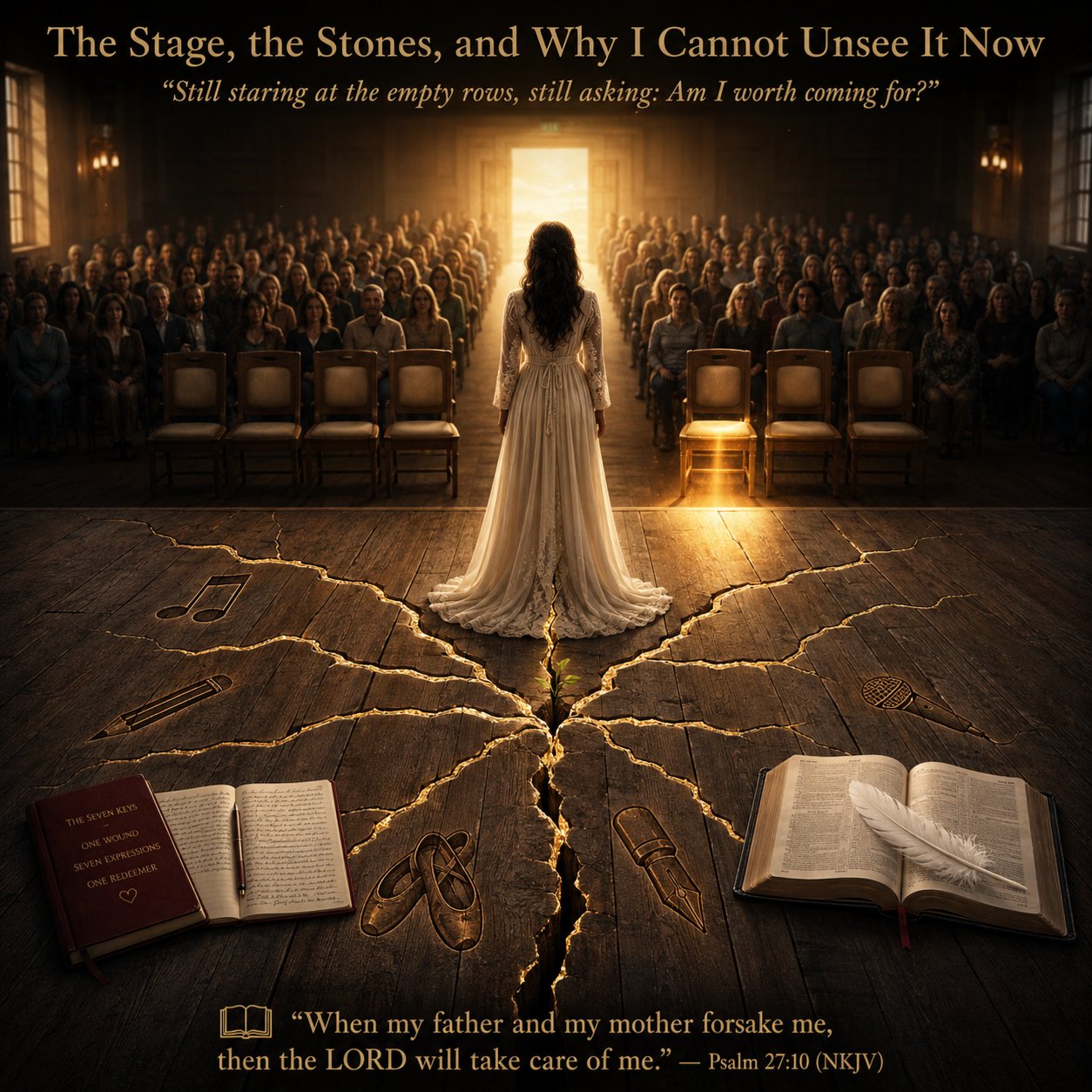
📖"When my father and my mother forsake me, then the LORD will take care of me."
I sat with the seven keys yesterday. All of them. Traced my hand across the pages, through singing and drawing and painting and dancing and writing and speaking and faith. Somewhere between those pages, a thread became visible that I can no longer pretend not to see.
Every single one was wounded the same way.
Not by different hands. Not by separate sorrows. The same absence arrived in different rooms, yet carried the same weight all the same.
It started in a school hall, a small girl dancing in Joseph's Technicolour Dreamcoat but no one that mattered there to see it. The empty seats of the people who mattered most taught her something in their silence — not about whether she could dance, but something far more fundamental: Am I worth coming for?
And underneath that question, she made an arithmetic that was so simple, so logical, so devastating: No one came. Therefore, this must not matter. Therefore, what I do must not matter. Therefore, perhaps I do not matter.
So she folded her joy into smaller squares. She made herself into what someone else needed instead of what she was.
Then a stage with a 16-year-old in a Dirndl, singing a solo in her mother tongue. Then another stage with a song, again, no one there to hear it. Then a choir door that closed. Then a microphone I was too afraid to approach. Then a pencil that went underground. Then a painting I believed I had no right to make. Then the ink that dried up. Then words I couldn't speak.
One central wound. Seven expressions of it. The same lie lived out in seven different rooms.
The empty row became evidence. Not truthful evidence — but evidence interpreted through the heart of a child who was learning to measure her own worth by who showed up.
I couldn't unsee it once I saw it.
Last night I couldn't sleep. Not from distress — from clarity. The kind of clarity that changes everything because it finally makes sense of everything. All those years I said I couldn't sing, couldn't dance, couldn't draw, couldn't write, couldn't speak, couldn't paint — it was never about ability. It was never even really about the empty seats themselves. It was about the sentence I decided to live under whilst looking at them.
The thinking shaped the becoming.
Now I understand why the next chapters will be harder to write. It's not because the material is raw. I've already written the raw. It's because I can no longer write about these seven keys with the luxury of unconsciousness. I can't describe how God healed my voice whilst still half-believing the old verdict about whether it was worth hearing. I can't celebrate painting whilst carrying the unspoken knowledge that I had painted myself smaller to be safe.
Awareness changes everything. Once you see the pattern, you cannot go back to writing as though you don't.
The deeper truth — the one that keeps me awake — is this: Every reader who picks up this book is sitting staring at an empty row somewhere.
How many people are asking, underneath everything else, Am I worth coming for? How many are speaking a sentence about their own worth they copied from someone else's absence? How many have folded their own joy into smaller and smaller squares, not because anyone demanded it, only because nobody seemed to notice when it was large?
If I'm going to finish this book, I can't do it half-conscious of that. I can't write about healing these seven keys without naming what they all have in common: they were not wounded by separate hands. They were all wounded by the same question, the same silence, the same lie.
The chapters ahead require me to write whilst knowing what I was denying before. That's the harder work. Not the remembering. The honesty. Embracing the fireball of pain to pursue my healing.
Yet — and this is where the Holy Spirit keeps interrupting my sleeplessness with something that feels almost like tenderness — He knew this pattern all along.
He didn't heal my voice without knowing about the empty rows. He didn't bring back my painting without seeing which stage I was standing on when I believed I had no right to make anything beautiful. He didn't open my heart to dancing without understanding that my body had learned to stay small.
He healed me knowing the full architecture of the wound. Not in spite of it. In the midst of it.
The truth is even more solid than I thought it was: God may heal us progressively, but He is never confused about the root.
I experienced singing being restored here, drawing elsewhere, painting somewhere else, dancing later still. Writing and speaking are still in progress. From my perspective, they looked like separate chapters. From God's perspective, He always saw the whole tree. I thought He was restoring branches. He knew He was healing the root.
Which means the chapters I'm about to write aren't about seven separate healings. They're about one wound, seven expressions, and a God who is relentless about restoring what was taken — not just the gifts themselves, but the truth about who I am.
That's harder to write.
That's also true.
I don't know how to do this work with full consciousness of what it means. Yet I know this much: The ones who need to read what I'm about to write are the ones still staring at the empty row, still asking underneath everything else, Am I worth coming for?
I am one of those readers.
I too am stuck staring at the empty rows my mum, my dad, and my brother were meant to occupy. Their absence is not ancient history I've processed and moved beyond. It's present. It's grief I'm still carrying. It's a question I'm still asking whilst I write about healing from the same question.
I cannot serve them — cannot serve myself — by pretending I can't see it anymore.
There is something I need to hold carefully here: The empty row was real. The verdict I drew from it was not.
The people really did fail to show up. The doors really did close. My creative life really was wounded. Loneliness really existed. I'm not rewriting history — I'm allowing God's truth to reinterpret what history meant about me.
The absence said something about what others could or could not give. It never had authority to pronounce my worth.
My story for His glory, changing the world 🌏 one 💔heart💖 at a time. — Patrizia
- When did I first learn to measure my worth by who showed up — and what would it look like to let God measure it instead?
- The empty row was real. But what if the verdict I drew from it was never the final word?
- If healing means allowing God to reinterpret what my history meant about me, rather than rewriting my history, what changes?
- What would it cost me to write about reclaiming my gifts not as proving I was worth something all along, but as standing with others still staring at their own empty rows?
I do not need to pretend unconsciousness to do this work. I do not need to be healed before I write about healing. Full honesty — about the pattern, the wound, the lie, the ongoing grief, and the price of seeing it — is not a weakness in these chapters. It is their foundation. God did not heal me so that I could write polished stories about triumph from a safe distance. He healed me so that I could write true stories about reclamation from within the fire. The seven keys are not proof that I was always worthy. They are doorways through which I — we — finally stop allowing an empty row to tell us we are not. My voice is not fragile. Neither am I.
Father, I see it now. The pattern. The absence that touched everything. The question underneath it all: *Am I worth coming for?* The verdict I drew from silence. The smaller squares I folded myself into. I cannot unsee it, and I'm asking You to help me not want to. I'm still staring at the empty rows. I'm still grieving. I'm still asking. And I'm choosing honesty anyway — not because I've moved beyond the wound, but because You've shown me that the ones still stuck in their own empty rows need to know they're not alone there. Give me the courage to embrace the fireball of pain to pursue this healing. Not to pretend it doesn't burn. Only to walk through it because truth lives on the other side. Protect my heart as I do this. Steady my hand. Remind me, when the weight of grief tries to silence me, that the very voice I'm about to use was the one that sat silent for five decades — silent because I believed it wasn't worth hearing. That voice is not fragile. It was never less than precious. And neither was I. In Jesus' Name, Amen.
Reflections from readers
Be the first to share a reflection. 💛
New testimonies arrive as the journey unfolds. Subscribe to follow along — straight to your inbox. 🕊️